
 EN
EN

How to Choose the Best Educational Keyboard for Schools in 2026 | Keysco
As schools continue to adopt tablets and digital learning tools, the question is no longer simply which tablet should we buy?
In 2026, schools and education technology providers are increasingly asking a more practical question:
How can we make tablets more productive, protected, and suitable for everyday classroom use?
For students who regularly write essays, complete assignments, take online tests, or use educational applications, touchscreen input alone may not provide the typing experience they need.
That is where an educational keyboard can make a difference.
However, not every keyboard is designed for the demands of a classroom.
So, what should schools look for when choosing a school tablet keyboard or keyboard case for education?
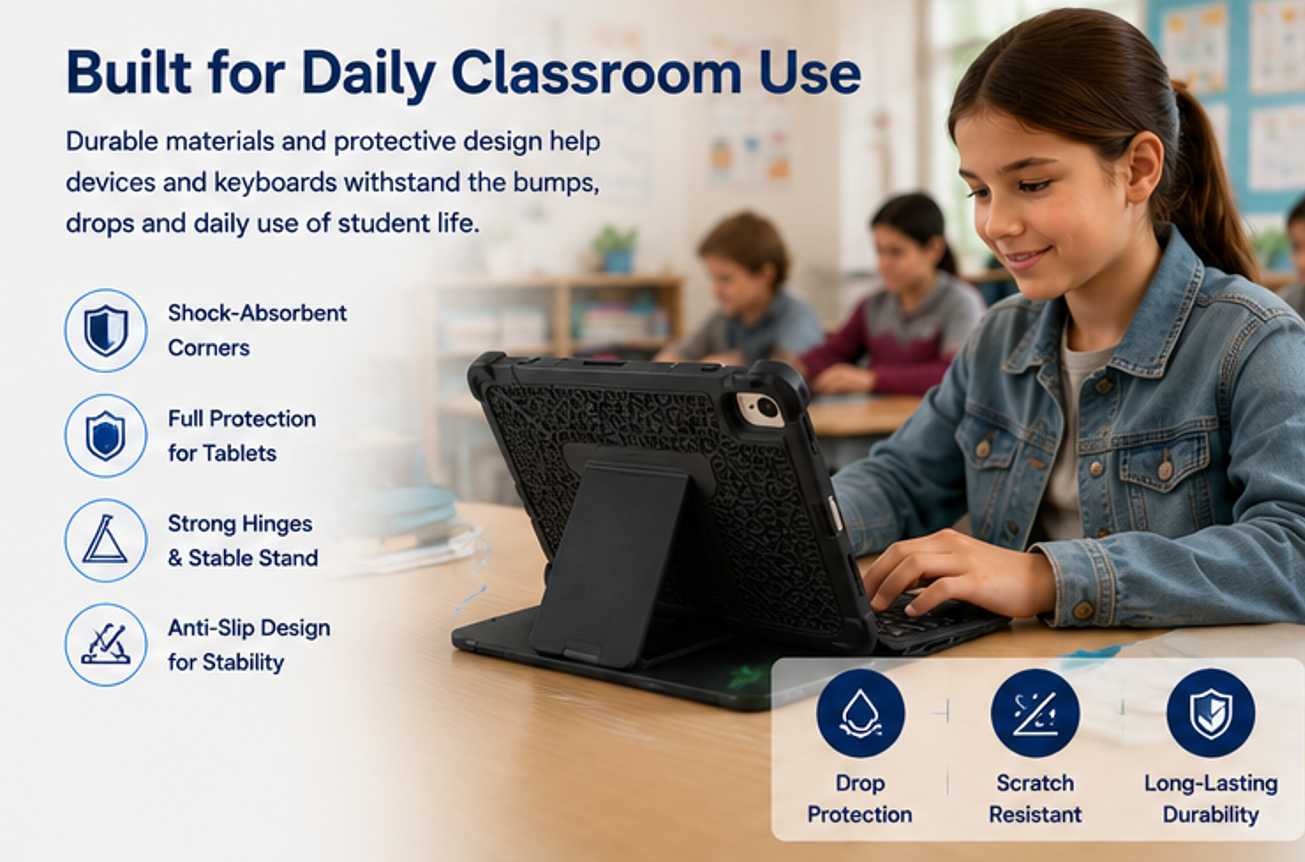
1. Durability Should Come First
Students use technology differently from office workers.
A keyboard used in a classroom may be carried in backpacks, moved between classrooms, shared between students, or accidentally dropped.
That means durability should be one of the first purchasing considerations.
A good durable educational keyboard should be designed for:
- Frequent daily typing
- Repeated opening and closing
- Student transportation
- Everyday classroom handling
- Long-term institutional use
For schools purchasing hundreds or thousands of units, product durability is particularly important because replacing accessories frequently can quickly increase the total cost of ownership.
Recent education technology purchasing research also shows that cost-effectiveness and durability remain important considerations for K-12 technology decisions.
2. Protection Is Just as Important as Typing
A school tablet is an investment.
A keyboard case that combines typing functionality and tablet protection can provide more value than a standalone Bluetooth keyboard.
For example, a well-designed keyboard case can help protect:
- The tablet screen
- Rear housing
- Corners and edges
- Hinges and connection areas
This is especially important in K-12 environments where devices are frequently transported between classrooms and home.
In Germany, for example, current school device programs increasingly bundle tablets with keyboards and other accessories as part of the overall student device package.
3. Think About the Student's Typing Experience
A tablet may be excellent for reading, browsing and interactive applications.
But when students need to write longer assignments, physical keys can provide a more familiar typing experience.
When evaluating an educational keyboard, schools should consider:
Tactile Feedback
Keys should provide clear and comfortable feedback without requiring excessive force.
Key Layout
The keyboard layout should match the target market and student age group.
For international education projects, localized layouts such as US, UK, German, French, Spanish or other language layouts may be required.
Stability
The keyboard case should provide a stable platform when students are typing at a desk.
Portability
Students still need to carry their devices between classrooms, so unnecessary weight and bulk should be avoided.
4. Battery Life and Connectivity Matter
For wireless educational keyboards, connectivity should be simple and reliable.
Teachers should not have to spend valuable classroom time troubleshooting Bluetooth connections or charging keyboards.
Schools should consider:
- Bluetooth stability
- Battery capacity
- Charging method
- Battery status indication
- Automatic sleep/wake functions
- Ease of pairing
For larger deployments, rechargeable keyboards with battery indicators can also make device management easier for school IT teams.
5. Don't Ignore the Total Cost of Ownership
The cheapest keyboard is not always the most cost-effective option.
For schools, the real cost can include:
Purchase price + replacements + maintenance + logistics + IT support
A keyboard that costs slightly more but lasts significantly longer may provide better value over its entire lifecycle.
This is especially important for large-scale deployments.
For example, one of the education projects featured in our case studies involved 3,000 iPads deployed with keyboard cases within six months. The project required not only competitive pricing, but also consistent quality and reliable batch production.
For schools and education distributors, the goal should be:
Lower total cost of ownership — not simply the lowest unit price.
6. OEM & ODM Can Make a Big Difference
For education distributors, EdTech companies and large school projects, standard products may not always be enough.
Different markets may require different:
- Tablet models
- Keyboard layouts
- Colors
- Logos
- Materials
- Packaging
- Functional configurations
- Protection levels
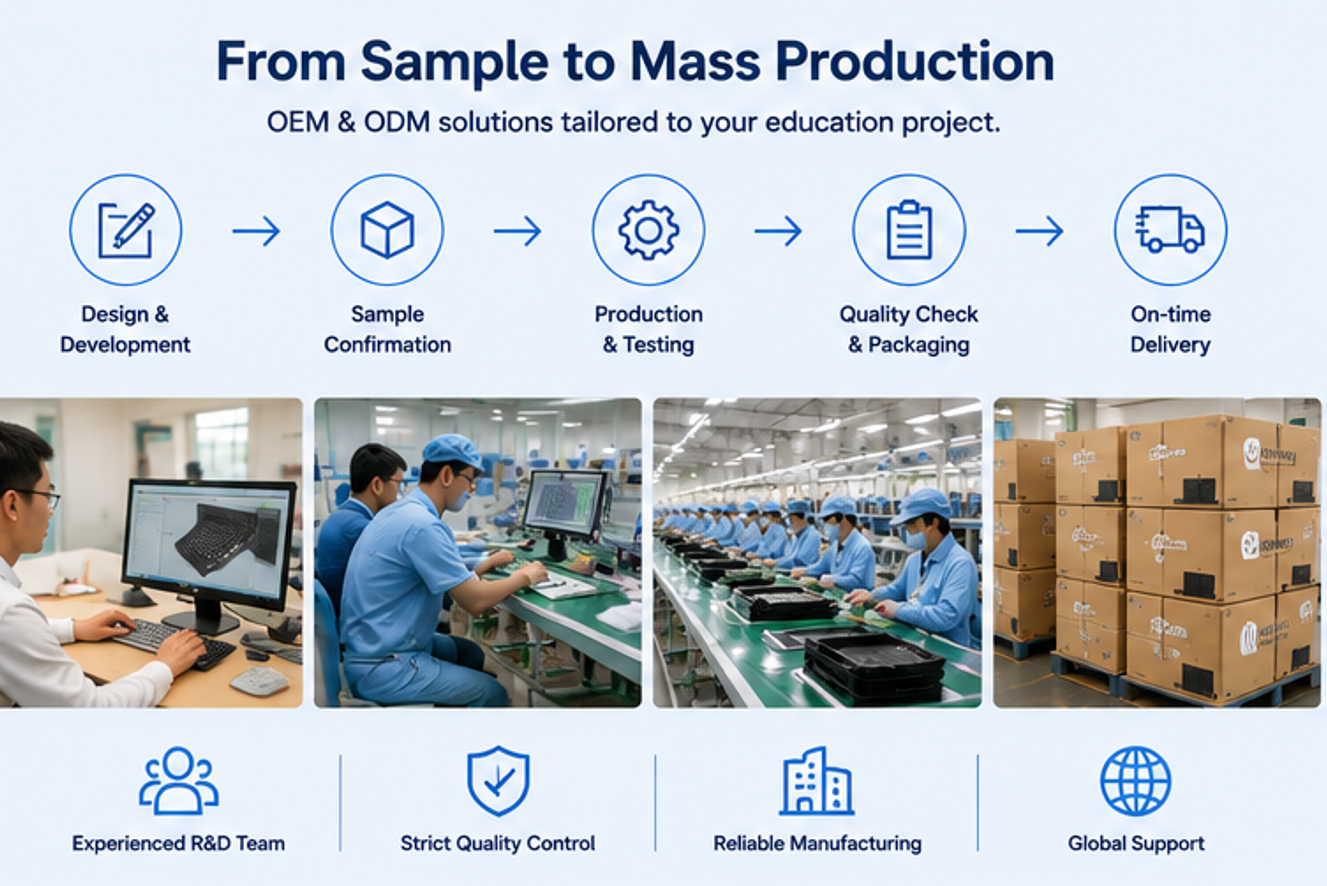
This is where OEM and ODM educational keyboard solutions become valuable.
A professional keyboard manufacturer can develop or customize products according to the customer's requirements.
For example, an education project may request:
School Logo + Specific iPad Model + Local Keyboard Layout + Customized Packaging
Instead of adapting the project around an existing retail product, the product can be developed around the actual requirements of the education market.
7. Choose a Manufacturer, Not Just a Keyboard
For a school purchasing 20 keyboards, the supplier's manufacturing capability may not seem critical.
For a project involving 500, 3,000 or 10,000 units, it becomes extremely important.
Before choosing an educational keyboard supplier, ask:
- Can you provide samples before mass production?
- Can you support OEM/ODM customization?
- Can you manufacture consistently at scale?
- What quality-control process do you use?
- Can you support different keyboard layouts?
- Can you provide customized packaging?
- Can you support long-term repeat orders?
- Can you provide after-sales support?
These questions can help schools and distributors avoid problems after the purchase order has already been placed.
Why Keysco for Educational Keyboard Solutions?
At Keysco, we focus on tablet accessories and keyboard solutions for global customers.
Our products are designed for applications including:
- K-12 schools
- Universities
- Language institutes
- Special education
- EdTech programs
- Education distributors
- Government education projects
Our manufacturing capabilities support both standard products and customized OEM/ODM projects.
From keyboard cases and Bluetooth keyboards to customized logos, layouts and packaging, we can work with customers from initial product selection through sampling and mass production.
Built for the Real Classroom
The classroom is very different from an office.
Students move devices.
Teachers need simple operation.
IT teams need reliable products.
Procurement teams need predictable costs.
That's why the best educational keyboard is not necessarily the one with the most features.
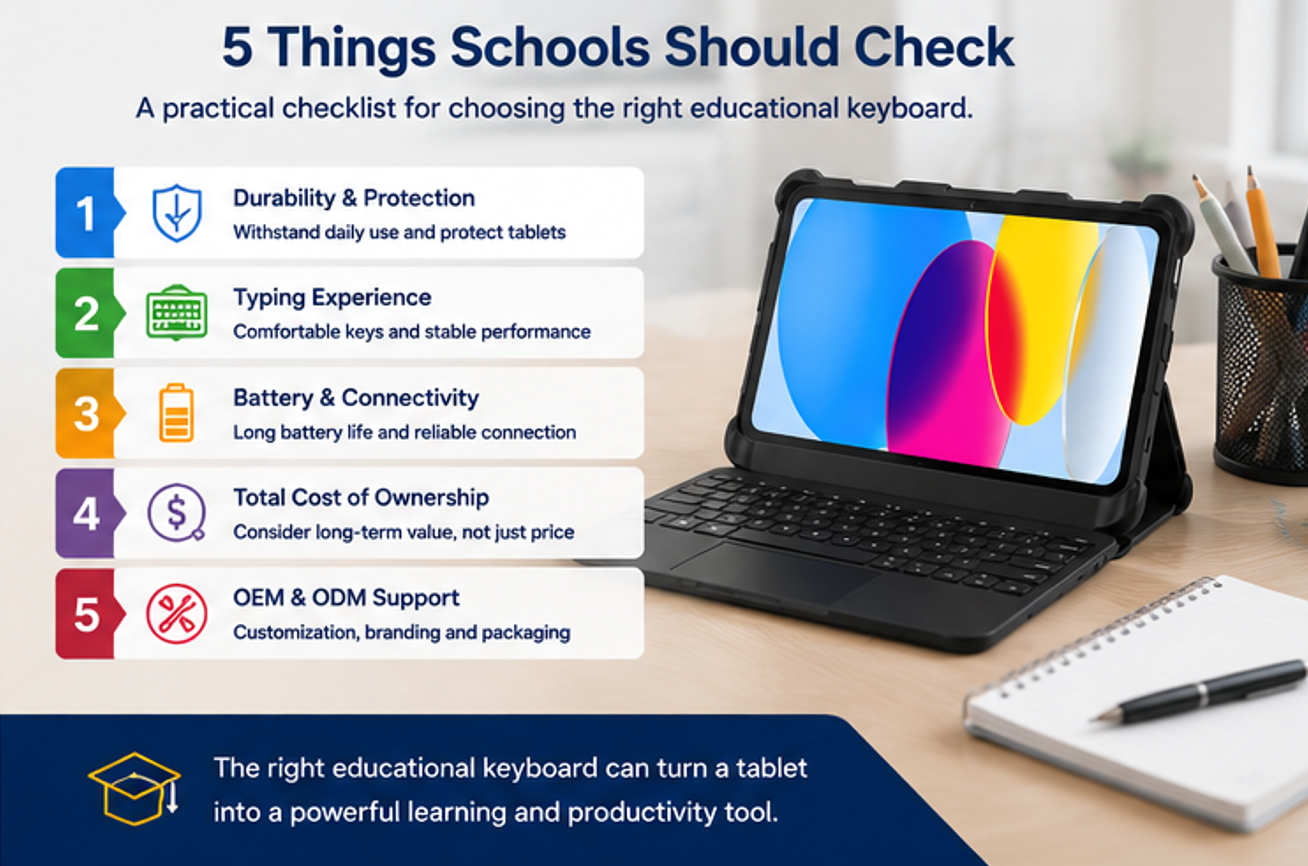
It is the one that can provide the right balance of:
Durability + Protection + Typing Experience + Cost Efficiency + Reliable Supply
And for large education projects, the ability to customize the product can make an even bigger difference.
Final Thoughts
As tablet-based learning continues to evolve, keyboards are becoming an important part of the overall student device ecosystem.
Schools should look beyond the keyboard itself and evaluate the complete solution:
How durable is it?
How well does it protect the tablet?
Is it comfortable for students?
Can the school manage hundreds or thousands of units?
Can the supplier provide OEM/ODM support?
Choosing the right school tablet keyboard can help turn a tablet from a simple touchscreen device into a more practical learning and productivity tool.
Looking for an Educational Keyboard Manufacturer?
Whether you are a school, education distributor, EdTech company or government procurement partner, Keysco can help develop the right tablet keyboard solution for your project.
Need samples? Need a customized logo? Need OEM/ODM development?
👉 Request a Quote
👉 Request a Sample
👉 Contact Keysco Education Team

