
 EN
EN

The Hidden Engineering Behind a Floating Keyboard: Hinge & Scissor-switch Secrets
There is a moment every engineer remembers. For me, it was the first time I held a Magic Keyboard for iPad Pro. I tilted it open, expecting the usual wobbly folio feel. Instead, the entire assembly moved as one solid block. The iPad floated in mid-air, connected to the keyboard by nothing visible except two small metallic folds. No kickstand. No thick base. Just a rigid, angled typing surface that seemed to defy physics.
"How does it stay up?" I asked our lead hinge engineer.
He smiled. "That‘s the hinge."
That question started a two-year journey into the mechanical soul of premium wireless keyboard designs – specifically, the marriage between hinge and scissor-switch that separates a $30 accessory from a $300 engineering marvel.
The Floating Illusion – What Most Brands Get Wrong
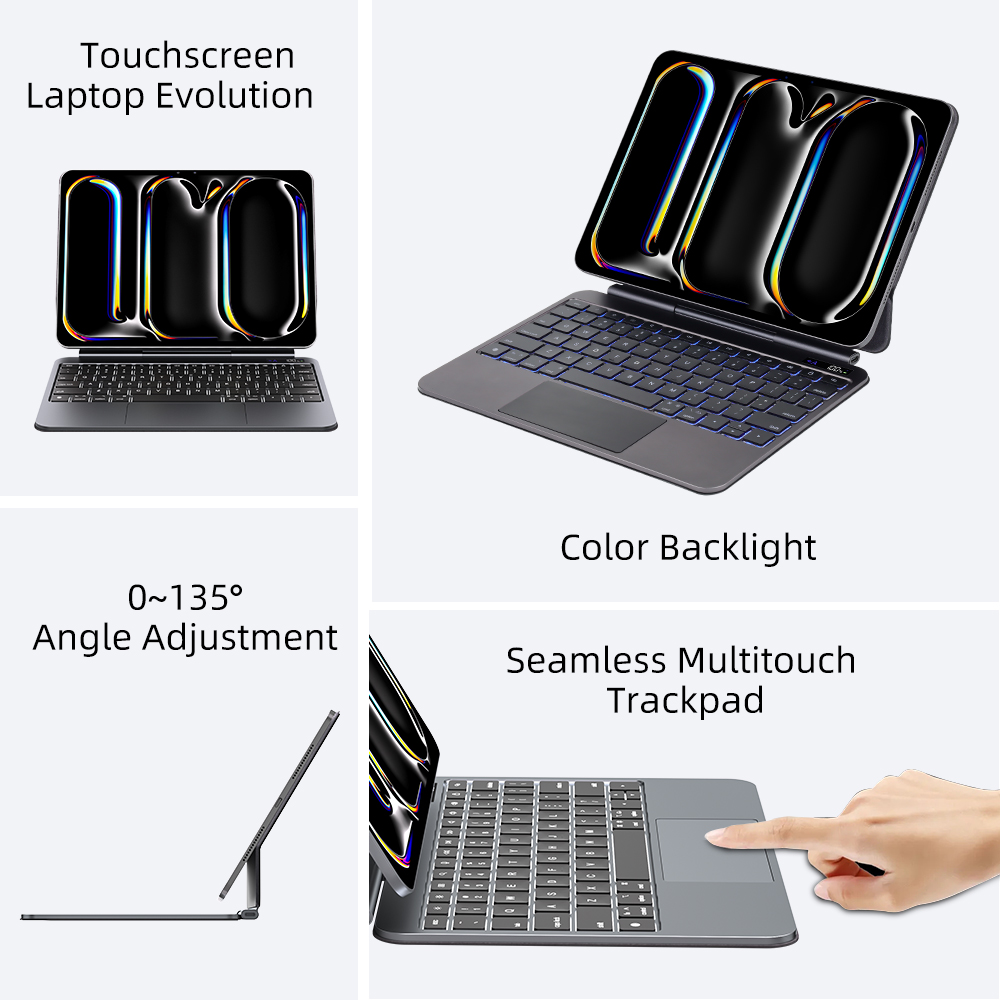
Most keyboard case designs follow a simple formula: a thick backplate, a fabric hinge, and a separate keyboard that folds over. The result is stable but bulky. Apple‘s Magic Keyboard achieved something different – a detachable-style floating cantilever where
The secret lies in a multi-link hinge system. Instead of a single pivot point, premium hinge designs use synchronized twin axes with precisely tuned torsion springs. When you open the lid, the first axis rotates about 30 degrees before engaging the second. This “dual-torque” behavior creates a smooth, progressive resistance that feels both light to start and rock-solid at any angle.
Our testing lab has reverse-engineered more than 20 competitor hinge designs. The best ones share three traits:
the iPad’s center of gravity sits directly over the hinge axis, creating a self-locking effect.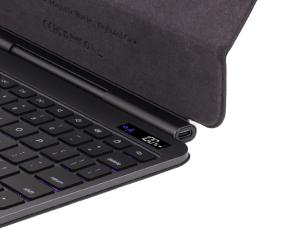
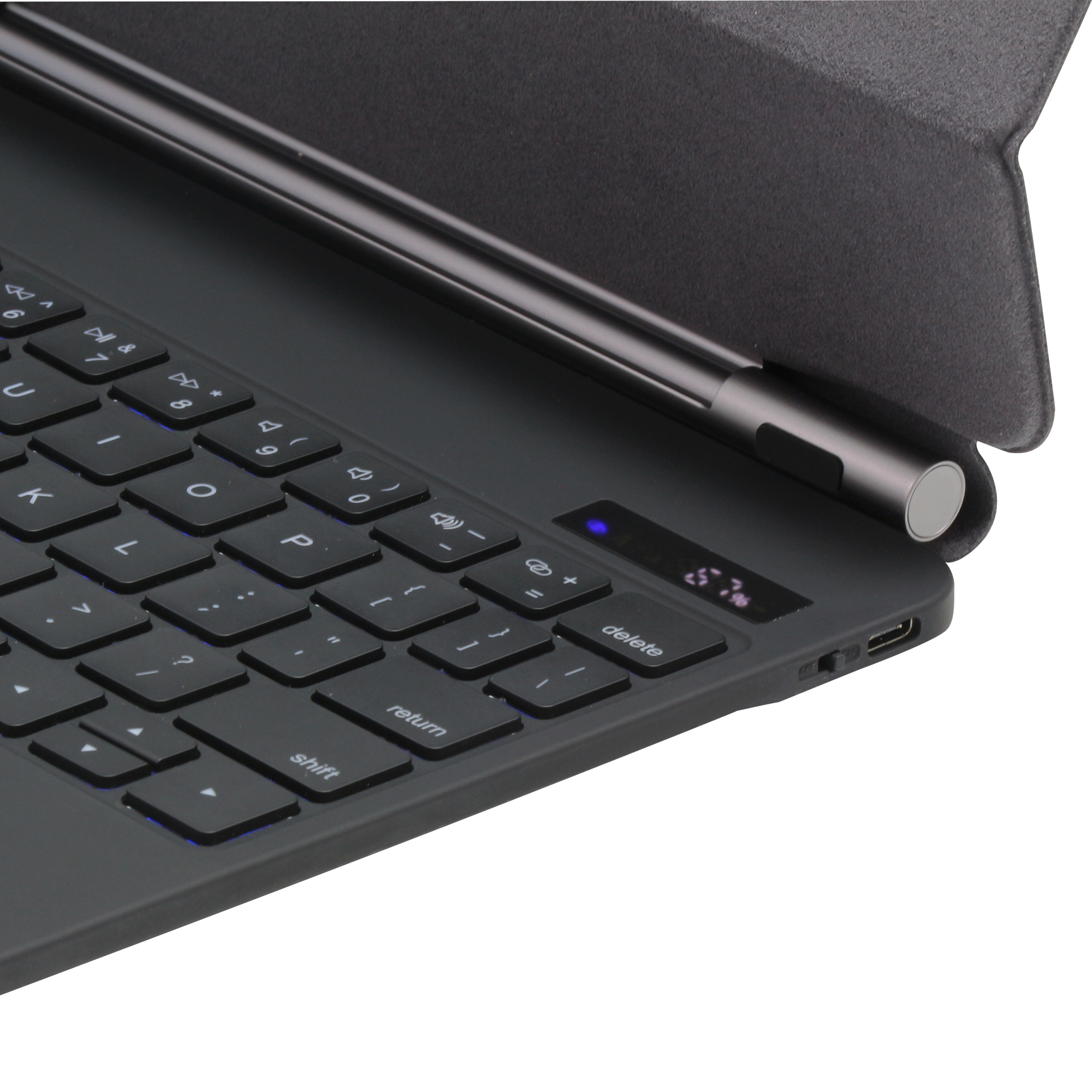
The secret lies in a multi-link hinge system. Instead of a single pivot point, premium hinge designs use synchronized twin axes with precisely tuned torsion springs. When you open the lid, the first axis rotates about 30 degrees before engaging the second. This “dual-torque” behavior creates a smooth, progressive resistance that feels both light to start and rock-solid at any angle.
Our testing lab has reverse-engineered more than 20 competitor hinge designs. The best ones share three traits:
1.Metal alloy gears – never plastic-on-plastic
2.Laser-welded torsion bars – consistent torque left vs. right
3.Cycle rating ≥15,000 opens – verified by robotic testers
Scissor-switch – The Silent Partner
While the hinge steals the spotlight, the scissor-switch does the daily work. Every key on a premium wireless keyboard relies on this X-shaped linking mechanism. When you press a key, the scissor arms collapse evenly, pushing a rubber dome that completes an electrical contact. When you release, the arms spring back – ready for the next keystroke.
But here‘s what most people don’t see: the subtle variations in scissor-switch design directly impact typing feel, noise, and long-term reliability.
Image suggestion: Exploded view of a single key – keycap, scissor-switch assembly (two interlocking X arms), rubber dome, and membrane layer.
|
Scissor Type |
Travel |
Tactility |
Durability |
Best Use |
|
Standard PC |
2.5mm |
Soft |
5M cycles |
Office keyboards |
|
Ultra-thin |
1.2mm |
Crisp |
10M cycles |
Notebook/laptop |
|
Magic Keyboard style |
1.5mm |
Sharp click |
15M cycles |
Premium keyboard case |
For a keyboard case that‘s only 5–7mm thick, the scissor-switch must achieve two contradictory goals: shallow enough to fit the slim profile, yet deep enough to feel satisfying. Our R&D team spent eight months optimizing a 1.5mm travel scissor-switch that uses a stainless steel cross-brace – a tiny metal reinforcement inside the plastic arms – to eliminate key wobble while maintaining a crisp bottom-out feel.
The Integration Challenge – Hinge + Switch + Bluetooth
A wireless keyboard is more than the sum of its parts. The hinge defines the posture, the scissor-switch defines the touch, and the Bluetooth module defines the connection. But engineering a detachable keyboard case that feels seamless requires solving two hidden conflicts:
Conflict 1: Hinge stiffness vs. portability. A stiff hinge feels premium but requires stronger magnets to keep the case closed. Stronger magnets interfere with Bluetooth antenna performance. Solution: Shielded ferrite magnets placed away from the radio module.
Conflict 2: Scissor-switch depth vs. backlit uniformity. Deeper key travel pushes LEDs farther from the keycap, reducing backlit brightness. Solution: Light-guide film with micro-patterns that redirects light upward, not sideways.
Why This Matters for Your Brand
If you‘re sourcing or manufacturing keyboard case products, understanding these mechanical details directly impacts your cost, quality, and customer reviews. Here‘s what we‘ve learned from producing over 4 million units for global clients:
1.Hinge cost correlates with cycle life. Cheap hinge lasts 5,000 cycles. High-priced hinge lasts 20,000 cycles. The difference pays for itself in warranty returns.
2.Scissor-switch tooling is a one-time investment. Once you approve a mold, you‘re locked in for 1–2 years. Test with at least 10 different keycap materials before finalizing.
3.Backlit keyboards have 40% higher average selling price but require 3x more QC steps. Plan your assembly line accordingly.
Final Takeaway
The next time you see a floating wireless keyboard, don‘t just admire the aesthetics. Look for the hinge – is it a single plastic barrel or a precision metal gear system? Feel the keys – do they wobble, or does the scissor-switch provide a satisfying snap? Test the Bluetooth connection – does it drop when you tilt the case?
These details separate a commodity from a masterpiece. And as a supplier, mastering them is how you become indispensable.

